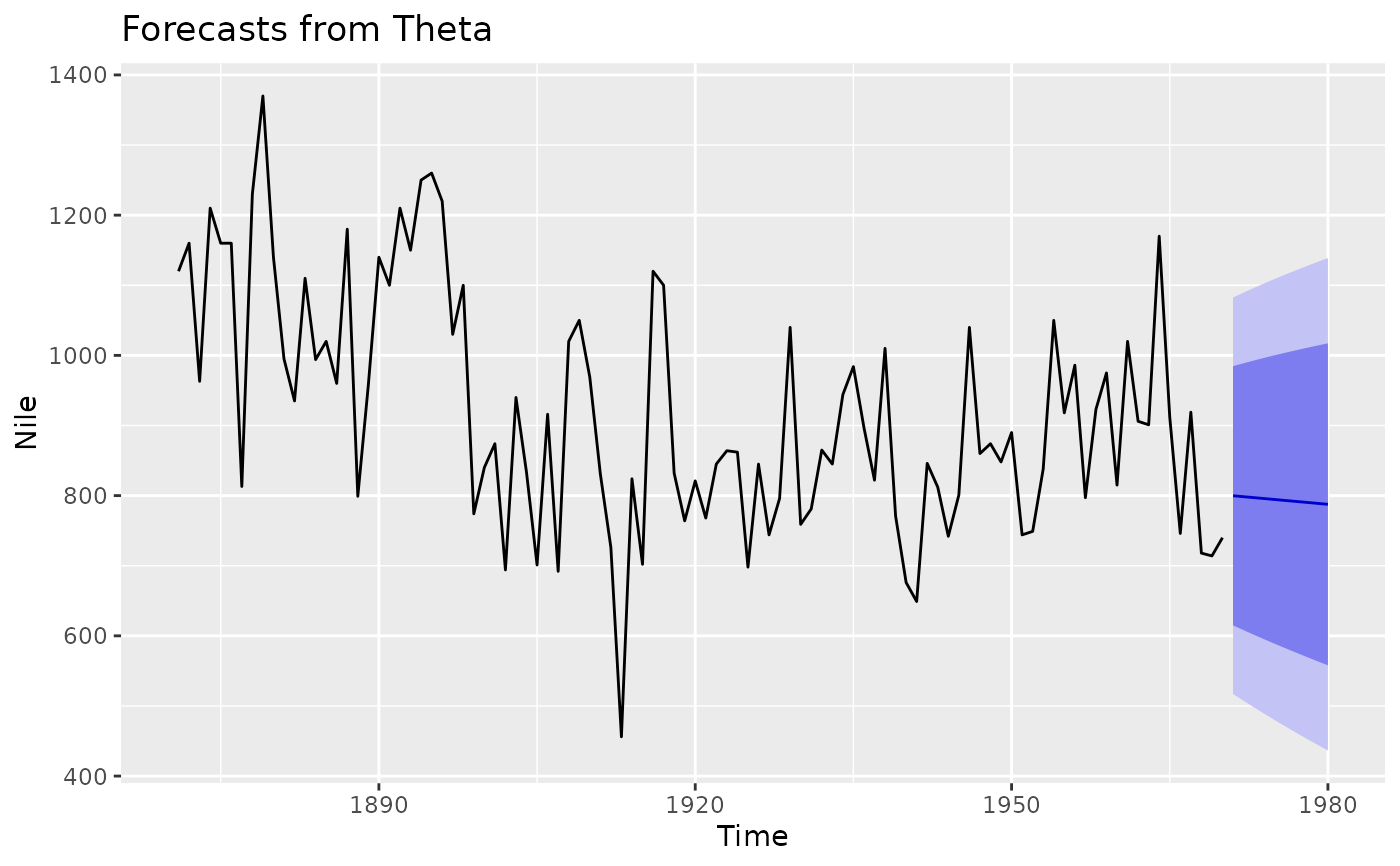
Returns forecasts and prediction intervals for a theta method forecast.
thetaf() is a convenience function that combines theta_model() and
forecast.theta_model().
The theta method of Assimakopoulos and Nikolopoulos (2000) is equivalent to
simple exponential smoothing with drift (Hyndman and Billah, 2003).
The series is tested for seasonality using the test outlined in A&N. If
deemed seasonal, the series is seasonally adjusted using a classical
multiplicative decomposition before applying the theta method. The resulting
forecasts are then reseasonalized.
Prediction intervals are computed using the underlying state space model.
Usage
# S3 method for class 'theta_model'
forecast(
  object,
  h = if (frequency(object$y) > 1) 2 * frequency(object$y) else 10,
  level = c(80, 95),
  fan = FALSE,
  lambda = object$lambda,
  biasadj = FALSE,
  ...
)

thetaf(
  y,
  h = if (frequency(y) > 1) 2 * frequency(y) else 10,
  level = c(80, 95),
  fan = FALSE,
  lambda = NULL,
  biasadj = FALSE,
  type = c("multiplicative", "additive"),
  x = y,
  ...
)
Arguments
- object
An object of class
theta_modelcreated bytheta_model().- h
Number of periods for forecasting. Default value is twice the largest seasonal period (for seasonal data) or ten (for non-seasonal data).
- level
Confidence levels for prediction intervals.
- fan
If
TRUE,levelis set toseq(51, 99, by = 3). This is suitable for fan plots.- lambda
Box-Cox transformation parameter. If
lambda = "auto", then a transformation is automatically selected usingBoxCox.lambda. The transformation is ignored if NULL. Otherwise, data transformed before model is estimated.- biasadj
Use adjusted back-transformed mean for Box-Cox transformations. If transformed data is used to produce forecasts and fitted values, a regular back transformation will result in median forecasts. If biasadj is
TRUE, an adjustment will be made to produce mean forecasts and fitted values.- ...
Other arguments passed to
forecast.ets.- y
a numeric vector or univariate time series of class
ts- type
Type of seasonal decomposition. Either
"multiplicative"(default) or"additive".- x
Deprecated. Included for backwards compatibility.
Details
More general theta methods are available in the forecTheta package.
forecast class
An object of class forecast is a list usually containing at least
the following elements:
- model
A list containing information about the fitted model
- method
The name of the forecasting method as a character string
- mean
Point forecasts as a time series
- lower
Lower limits for prediction intervals
- upper
Upper limits for prediction intervals
- level
The confidence values associated with the prediction intervals
- x
The original time series.
- residuals
Residuals from the fitted model. For models with additive errors, the residuals will be x minus the fitted values.
- fitted
Fitted values (one-step forecasts)
The function summary can be used to obtain and print a summary of the
results, while the functions plot and autoplot produce plots of the forecasts and
prediction intervals. The generic accessor functions fitted.values and residuals
extract various useful features from the underlying model.
References
Assimakopoulos, V. and Nikolopoulos, K. (2000). The theta model: a decomposition approach to forecasting. International Journal of Forecasting 16, 521-530.
Hyndman, R.J., and Billah, B. (2003) Unmasking the Theta method. International J. Forecasting, 19, 287-290.
Examples
nile_fit <- theta_model(Nile)
forecast(nile_fit) |> autoplot()