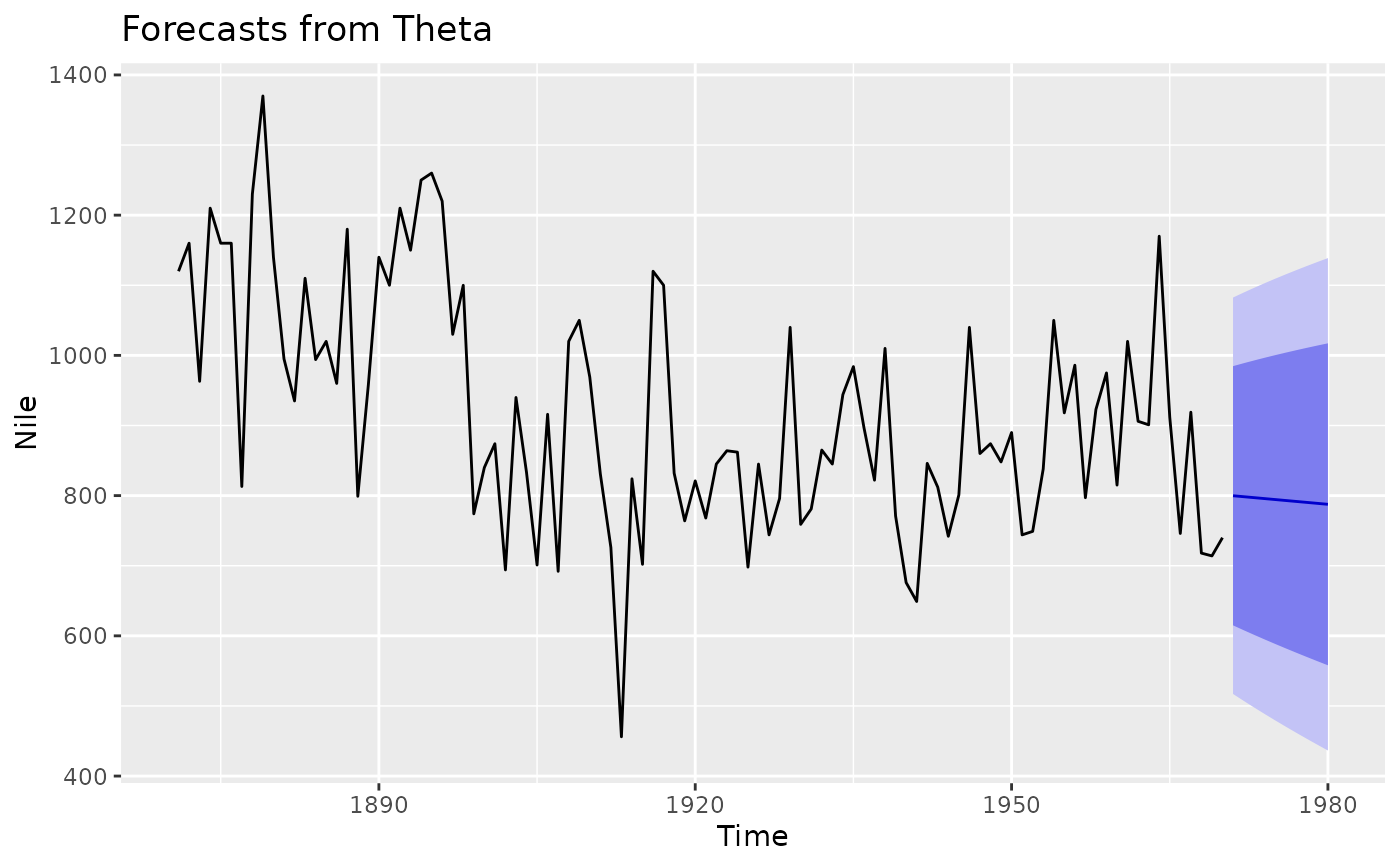
The theta method of Assimakopoulos and Nikolopoulos (2000) is equivalent to simple exponential smoothing with drift (Hyndman and Billah, 2003). This function fits the theta model to a time series. The series is tested for seasonality using the test outlined in A&N. If deemed seasonal, the series is seasonally adjusted using a classical multiplicative decomposition before fitting the theta model.
Usage
theta_model(
  y,
  lambda = NULL,
  biasadj = FALSE,
  type = c("multiplicative", "additive")
)
Arguments
- y
a numeric vector or univariate time series of class
ts- lambda
Box-Cox transformation parameter. If
lambda = "auto", then a transformation is automatically selected usingBoxCox.lambda. The transformation is ignored if NULL. Otherwise, data transformed before model is estimated.- biasadj
Use adjusted back-transformed mean for Box-Cox transformations. If transformed data is used to produce forecasts and fitted values, a regular back transformation will result in median forecasts. If biasadj is
TRUE, an adjustment will be made to produce mean forecasts and fitted values.- type
Type of seasonal decomposition. Either
"multiplicative"(default) or"additive".
Details
More general theta methods are available in the forecTheta package.
References
Assimakopoulos, V. and Nikolopoulos, K. (2000). The theta model: a decomposition approach to forecasting. International Journal of Forecasting 16, 521-530.
Hyndman, R.J., and Billah, B. (2003) Unmasking the Theta method. International J. Forecasting, 19, 287-290.