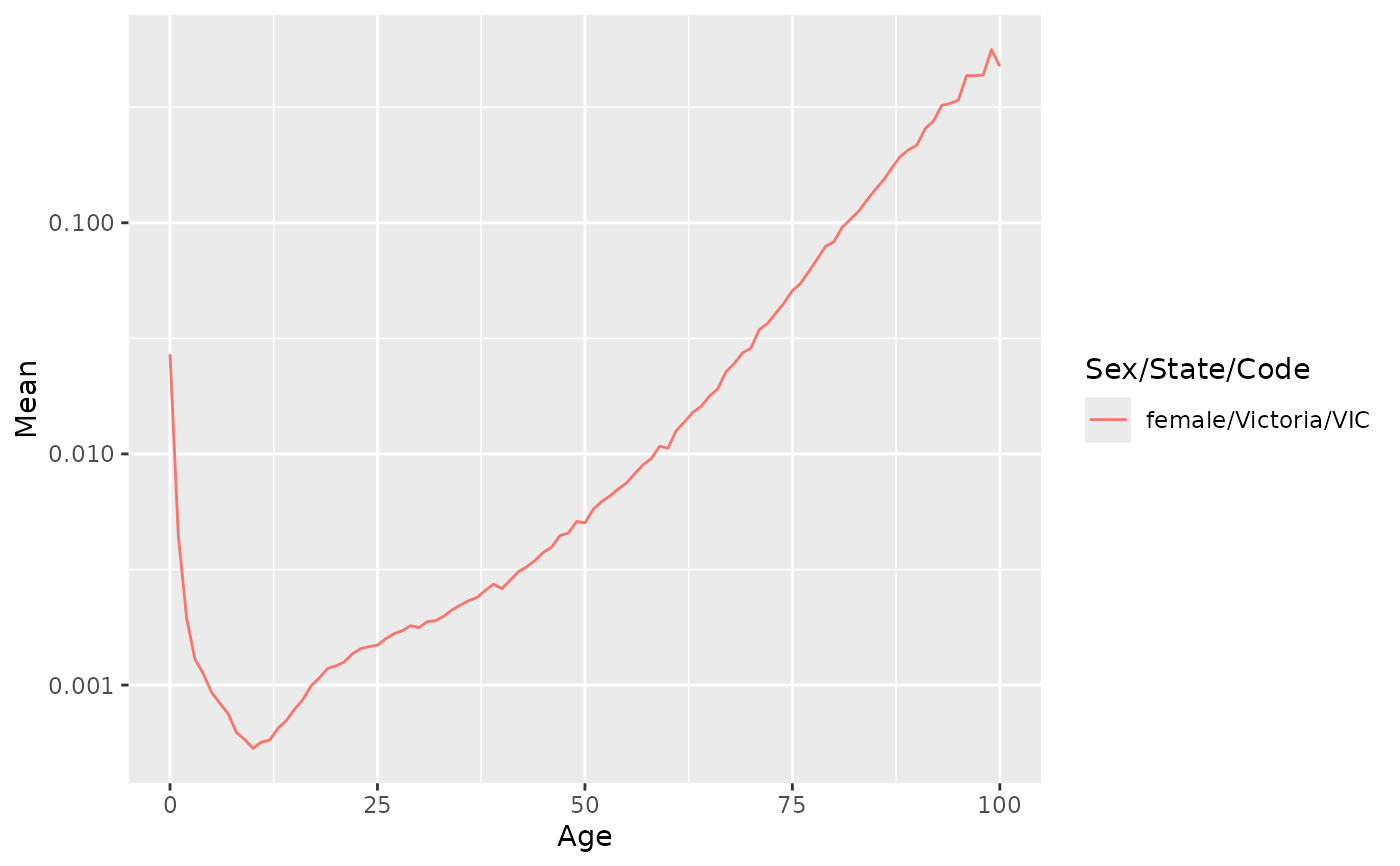
FMEAN() returns an iid functional model applied to the formula's response variable as a function of age.
Standard deviations that cannot be estimated, such as at ages with fewer
than two finite residuals, are interpolated from neighbouring ages.
Simulations from generate() with bootstrap = TRUE resample whole years
of residuals, so they keep the correlation between ages. Otherwise, ages are
simulated independently from normal distributions, which understates the
uncertainty of quantities computed across ages, such as life expectancy.
Examples
fmean <- norway_mortality |>
  dplyr::filter(Sex == "Female") |>
  model(mean = FMEAN(Mortality))
report(fmean)
#> Series: Mortality
#> Model: FMEAN
#>
#> # A tibble: 111 × 3
#>      Age     mean   sigma
#>    <int>    <dbl>   <dbl>
#>  1     0 0.0231   0.0212
#>  2     1 0.00616  0.00763
#>  3     2 0.00262  0.00324
#>  4     3 0.00179  0.00215
#>  5     4 0.00144  0.00173
#>  6     5 0.00124  0.00152
#>  7     6 0.00109  0.00134
#>  8     7 0.000972 0.00118
#>  9     8 0.000907 0.00111
#> 10     9 0.000879 0.00113
#> # ℹ 101 more rows
autoplot(fmean) + ggplot2::scale_y_log10()